
The current wage revision for PSBs, as well as some private lenders, is due from November 2017 for five years - up to October 2022.
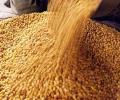
Distributing chana is easier than other varieties of pulses as it only requires cleaning and sorting and can be consumed whole; it was also abundantly available with Nafed.
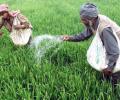
Kerala, Punjab, Telangana and Andhra Pradesh are among the major agriculturally important states that have banned the use of glyphosate citing its adverse impact on human health.

'We have already sanctioned loans worth over Rs 3,000 crore to around 120,000 customers.'

Apart from Bihar, Chhattisgarh and Jharkhand, where none of the estimated 6.7 million construction workers got cash transfer benefits, the coverage of the construction workers was the lowest in Delhi, where only about 5 per cent of the estimated workers received cash under the PMGKY, followed by Kerala and Uttar Pradesh (22 per cent), among major states. In India, construction workers belong to the unorganised sector but account for the highest share of non-farm jobs after manufacturing.
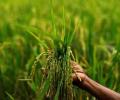
Data from department of agriculture showed that kharif crops had been sown in around 31.56 million hectares till Friday, which was 104.25 per cent more than the same period last year. Acreage of almost all crops was higher than last year.

Experts say while the increasing demand for a ban on Chinese goods might make for good optics, the reality is that India is still heavily dependent on that country in a wide range of industries like electronics, mobile devices, auto, pharma, telecom equipment, and fertilisers.


The company stated that it was taking steps for cost rationalisation across all businesses to maintain liquidity and due to a prolonged slowdown it had to take a few tough measures.

The Centre has advised banks to make a 20 per cent reduction in expenditure related to non-core business activities, along with deferring "avoidable expenditure" on "purchase of staff cars", "refurbishment of guest houses" and on the interior decoration of administrative and back offices.
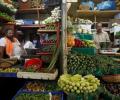
Since March 2020, WPI food inflation rate continued to fall but the CPI-food inflation rose, signaling a breakdown in supply chain from the mandis to the final household.
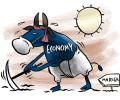
'A proposal to do away with labour laws is not feasible.' 'That's why we wanted to have a dialogue with the states.'

Till date, MP has procured around 12.77 million tonnes of wheat, which is expected to reach 13 million tonnes by the time the process ends in the next few weeks.
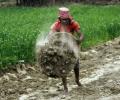
Kiran Vissa, co-convenor of National Alliance for Sustainable Agriculture, said that amendments to the EC Act have nothing to do with farmers' welfare but instead meant to please big players and agriculture companies. This is because small and marginal farmers don't have the storage capacity to attract provisions of the EC Act.
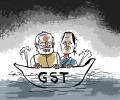
Retaining the GST rate assumes importance since states are under pressure to increase their revenues, hit hard by lockdown. Also, the Centre has not fully compensated states for their revenue losses on account of GST for 2019-20.
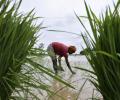
As the growth figures relate to pre-Covid lockdown period it does not reflect the real picture of distress which unfolded from April onwards in the sector, when acute supply disruption led to sharp drop in prices of many commodities largely perishables impacting farmers.

The locusts initially entered Rajasthan from Pakistan and from there the swarms moved towards Madhya Pradesh, Haryana, and Punjab over the last few weeks and are now threatening to enter Uttar Pradesh, putting at risk the summer crop.
ILO acts upon a plea by 10 central trade unions objecting to the ordinances proposed to temporarily scrap labour laws in Uttar Pradesh and Gujarat, along with executive orders issued by at least 10 states to increase the daily working limit to 12 hours from eight hours, along with other labour law changes.

Labour law changes for three years may not be enough as it takes a couple of years for factories to build and operations at a proper scale start only in the third or fourth year.

'The spirit of cooperation between the Centre and states has been diluted in many ways.' 'The level of consultation which used to be there earlier has reduced significantly.'
 © 2026 Rediff.com - Advertise with us - Disclaimer - Privacy Policy - Sitemap - Feedback - About us - Terms of use - Grievances